

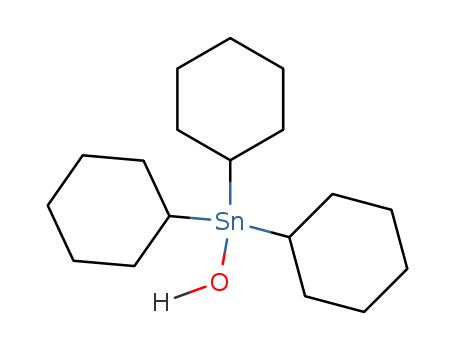
- Product NameCyhexatin
- cas13121-70-5
- purity99%

Agrochemicals
Factory Supply Industrial Grade Cyhexatin 13121-70-5 with Best Price
- Molecular Formula:C18H34OSn
- Molecular Weight:385.177
- Appearance/Colour:Colorless to white, nearly odorless, crystalline powder
- Vapor Pressure:0mmHg at 25°C
- Melting Point:195-198 °C
- Boiling Point:426.146 °C at 760 mmHg
- PKA:6.76±0.70(Predicted)
- Flash Point:211.526 °C
- PSA:20.23000
- LogP:5.92710
Cyhexatin(Cas 13121-70-5) Usage
|
Reactivity Profile |
Cyhexatin is incompatible with strong oxidizing agents. Soluble in some organic solvents (acetone 1.3 g/L; xylenes 3.6 g/L; carbon tetrachloride 28 g/L; dichloromethane 34 g/L). Stable in aqueous suspensions in neutral and alkaline pH (above pH 6), but reacts exothermically as a base in the presence of strong acids to form salts. Converts to dicyclohexyltin oxide and further to cyclohexylstannoic acid upon exposure to ultraviolet radiation. |
|
Safety Profile |
Poison by ingestion, inhalation, and intraperitoneal routes. Moderately toxic by skin contact. Experimental reproductive effects. When heated to decomposition it emits acrid smoke and irritating fumes. See also TIN COMPOUNDS. |
|
Potential Exposure |
Used as an agricultural chemical and pesticide. A potential danger to those involved in the manu- facture, formulation, and application of this acaricide (miticide). |
|
Metabolic pathway |
There is little published information of the degradation and metabolism of cyhexatin. However, useful information on the fate of cyhexatin in a water/sediment system can be deduced from published data on azoc yclotin. |
|
Shipping |
UN2786 Organotin pesticides, solid, toxic, Hazard Class: 6.1; Labels: 6.1-Poisonous material. UN2811 Toxic solids, organic, n.o.s., Hazard Class: 6.1; Labels: 6.1- Poisonous materials, Technical Name Required. |
|
Degradation |
Cyhexatin is stable to hydrolysis at temperatures up to 100 °C from slightly acid (pH 6) to alkaline conditions (PM). |
|
Incompatibilities |
Incompatible with strong oxidizers. May react exothermically as base in the Incompatible with strong oxidizers. May react exothermically as base in the Incompatible with strong oxidizers. Reacts exothermically as base in the presence of strong acids, forming salts. Keep away from ultraviolet radiation which may cause conver- sion to dicyclohexyltin oxide and further to cyclohexylstan- noic acid . |
|
General Description |
Technical Cyhexatin is a nearly odorless white crystalline powder that has no true melting point but degrades to bis(tricyclohexyl)tin oxide at 121 to 131°C which decomposes at 228°C; a melting point of 195-198°C is also reported. Very insoluble in water (less than 1 mg/L at 25°C), but wettable by water. Soluble in some organic solvents (acetone 1.3 g/L; xylenes 3.6 g/L; carbon tetrachloride 28 g/L; dichloromethane 34 g/L). Used as an acaricide (an agent to kill plant-feeding mites) in almonds, walnuts, hops and some fruits. |
InChI:InChI=1/3C6H11.H2O.Sn/c3*1-2-4-6-5-3-1;;/h3*1H,2-6H2;1H2;/q;;;;+1/p-1/rC18H34OSn/c19-20(16-10-4-1-5-11-16,17-12-6-2-7-13-17)18-14-8-3-9-15-18/h16-19H,1-15H2
13121-70-5 Relevant articles
ACTIVE COMPOUND COMBINATIONS HAVING INSECTICIDAL AND ACARICIDAL PROPERTIES
-
, (2010/08/18)
The novel active compound combinations c...
Further study of tris(cyclohexyl)stannane compounds, Cy3SnX. Syntheses of the compounds with X = Br, I, N3 and NCS and redetermination of the crystal structures of Cy3SnX (X = Br and I)
Howie, R. Alan,Moura, Marcelo V.H.,Wardell, James L.,Wardell, Solange M.S.V.
, p. 2331 - 2336 (2008/10/09)
Compound sythesis and far IR data are pr...
Macrocyclic plant acaricides
-
, (2008/06/13)
Compounds of the formula I STR1 in which...
Tricyclohexyl tin halides and pseudohalides: Structural and biocidal activity
Awasthi,Bhattacharya,Verma
, p. 264 - 268 (2007/10/02)
-
13121-70-5 Process route
-

-
3091-32-5
tricyclohexyltin(IV) chloride

-

-
5837-26-3
bis(tris(cyclohexyl)tin) oxide

-

-
13121-70-5
cyhexatin
Conditions
| Conditions | Yield |
|---|---|
|
With
NaOH;
In
sodium hydroxide;
aq. NaOH; with equal amount of NaOH;
|
-

-
3023-92-5
tris(cyclohexyl)tin bromide
-
-
13121-70-5
cyhexatin
Conditions
| Conditions | Yield |
|---|---|
|
With
potassium hydroxide;
In
ethanol;
recrysd. from alcohol;
|
13121-70-5 Upstream products
-
3091-32-5
tricyclohexyltin(IV) chloride
-
1310-73-2

sodium hydroxide
-
3023-92-5
tris(cyclohexyl)tin bromide
13121-70-5 Downstream products
-
117012-58-5

(C6H5)3SnSSn(C6H11)3
-
3091-32-5
tricyclohexyltin(IV) chloride
-
13121-86-3

tris(cyclohexyl)tin iodide
-
3023-92-5
tris(cyclohexyl)tin bromide
The order has been successfully placed. Our staff will contact you within 24 hours.